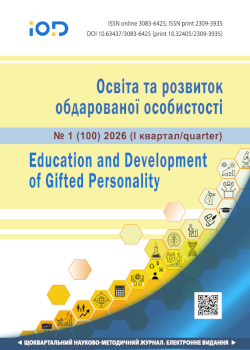
Scientific and Methodological Resources for Psychological Support of the Educational Process in the Conditions of Martial
DOI:
https://doi.org/10.32405/2413-4139-2020-1(28)-79-85Keywords:
support, adaptation, methodological support, educational process, martial lawAbstract
The article presents a description of methodological support designed for educational institutions and
promotes the processes of adaptation in today's conditions, as well as socialization in new socio-cultural
conditions for a wide range of readers (teachers, psychologists, parents, high school children, students, etc.).
Psychological support is provided by optimizing the psychological state of a person, which reduces the
relevance of psychological problems that hinder educational, personal and social self- realization at each stage
of life of individuals, small groups, groups, formal and informal associations of people.
In the conditions of martial law, the problem of supporting the adaptation and socialization of displaced
persons (on the territory of Ukraine and abroad) becomes especially relevant, especially for children. It is
also necessary to take into account the current circumstances of the organization of the educational process
of educational institutions in the format of distance learning. Since most students develop their intellectual
and other abilities mostly in a virtual environment, participants in the educational process may find useful
a number of scientific and methodological literature developed by the staff of the Institute. First of all, this
applies to guidelines for creating optimal conditions for the intellectual development of students in the
Internet environment; prevention of possible destructive effects of the Internet on the student's personality;
implementation of interactive psychological and pedagogical support for the socialization of gifted students;
programs to promote the process of adaptation of students of educational institutions.
Employees of the department constantly spread information (photos, videos, official news, etc.) about
war crimes on their Facebook pages, which the aggressor inflicts on the peaceful Ukrainian population so that
the whole world knows the truth.
Downloads
References
1. Androsovych, K. A. (2021). Sotsializatsiia obdarovanykh uchniv zasobamy informatsiinykh ta
komunikatsiinykh tekhnolohii [Socialization of gifted students by means of information and communication
technologies]. Informatsiini tekhnolohii i zasoby navchannia – Information Technologies and Teaching Aids,
84 (4), P. 21–37. DOI: https://doi.org/10.33407/itlt.v84i4.3538. [in Ukrainian].
2. Androsovych, K. A., & Tkachenko, L. I. (2018). Profilaktyka destruktyvnoi sotsializatsii obdarovanykh
starshoklasnykiv v Internet- seredovyshchi [Prevention of destructive socialization of gifted high school students
in the Internet environment]. Kyiv. [in Ukrainian].
3. Androsovych, K. A., & Tkachenko, L. I. (2021). Tekhnolohii psykholoho- pedahohichnoho
zabezpechennia adaptovanosti obdarovanoi osobystosti do novykh umov navchannia [Technologies of
psychological and pedagogical support of adaptability of the gifted person to new conditions of training].
Kyiv. 48 p. Retrieved from: https://lib.iitta.gov.ua/728948/. [in Ukrainian].
4. Androsovych, K. A., Ilina, H. V., Tkachenko, L. I., & Yakymova, I. O. (2021). Psykholohichni ta
sotsialni chynnyky adaptatsii obdarovanoi osobystosti v umovakh informatsiino- osvitnoho seredovyshcha
zakladiv zahalnoi serednoi osvity [Psychological and social factors of adaptation of the gifted person in the
conditions of the information- educational environment of establishments of general secondary education].
Kyiv. 138 p. [in Ukrainian].
5. Androsovych, K. A., Tkachenko, L. I., & Ilina, H. V. et al. (2021). Sotsialna adaptatsiia obdarovanoi
osobystosti: vid dytynstva do yunosti [Social adaptation of a gifted person: from childhood to adolescence].
Kyiv. 106 p. Retrieved from: https://lib.iitta.gov.ua/728920/. [in Ukrainian].
6. Habermas, Yu. (2006). Zaluchennia Inshoho. Studii z politychnoi teorii [Involvement of the Other.
Studies in political theory]. Lviv. [in Ukrainian].
7. Halchenko, M. S., Androsovych, K. A., Tkachenko, L. I., Kovalova O. A., & Naidonova L. M.
(2018). Interaktyvna psykholoho- pedahohichna pidtrymka sotsializatsii obdarovanykh uchniv [Interactive
psychological and pedagogical support for the socialization of gifted students]. Kyiv. [in Ukrainian].
8. Kamyshyn, V. V., Tkachenko, L. I., Androsovych, K. A., & Burhun, I. V. (2017). Psykholoho-
pedahohichnyi suprovid sotsializatsii obdarovanykh starshoklasnykiv v Internet- seredovyshchi [Psychological
and pedagogical support of socialization of gifted high school students in the Internet environment]. Kyiv. [in
Ukrainian].
9. Riker, P. (2000). Sam yak inshyi [Himself as another]. Kyiv. [in Ukrainian].
10. Smit, E. D. (1994). Natsionalna identychnist [National identity]. Kyiv. [in Ukrainian].
11. Abu- Hamour, Bashir; Al- Hmouz, Hanan, A. (2013). Study of Gifted High, Moderate, and Low
Achievers in Their Personal Characteristics and Attitudes toward School and Teachers. International Journal
of Special Education. v. 28 (3). P. 5–15. Retrieved from: https://eric.ed.gov/?id=EJ1024419.
12. Androsovych, К., Rudyk Yar., Melnyk, M., Kovalova, О., Yakymova, Ir. (2021). Psycholigical
Guidance of the Socialisation Process of Gifted Students using ICT means. Journal of Intellectual Disability –
Diagnosis and Treatment, Lifescience Global. Vol. 9. No. 2. Р. 236–246. DOI: https://doi.org/10.6000/2292- 2598.2021.09.02.11.
13. Afuzova, H., Ogorodniychuk, Z., Pavelkiv, V., Mamicheva, O., Prokofieva, O., & Androsovych,
K. (2022). Determinants of Professional Orientation of Future Psychologists on Correctional Support of
Children with Psychophysical Disorders. BRAIN. Broad Research in Artificial Intelligence and Neuroscience,
13 (1Sup1), P. 188–206. DOI: https://doi.org/10.18662/brain/13.1Sup1/312.
14. Erikson, E. (1968). Identity, Youth and Crisis. New York, Norton Company.
15. Historical Dictionary of Ukraine (2005). By Z. Kohut, B. Nebesio, M. Yurkevich (Eds.). Maryland.
Toronto; Oxford.
16. Honneth, A. (2000). Struggle for Recognition. Cambridge: Mit Press.
17. Garrett, B. (1998). Personal Identity and Self- Consciousness. London: Routledge.
18. Glover, J. (1988). The Philosophy and Psychology of Personal Identity. London: Penguin.
19. Lisovenko, A., Kriukova, M., Absalyamova, L., Chukhrii, I., Korchakova, N., & Androsovych, K.
(2022). Neuropsychological Fundamentals of Envy. BRAIN. Broad Research in Artificial Intelligence and
Neuroscience. 13(1), P. 158–172. DOI: https://doi.org/10.18662/brain/13.1/274.
20. Lisa Conrad (2022). Personal Goal Setting and Self- Regulation for Gifted Children. Roeper Review.
Т17, (V3). Retrieved from: https://globalgtchatpoweredbytagt.wordpress.com/2019/03/11/personal- goal-
setting- and- self- regulation- for- gifted- children/.
21. Pamela, R. Clinkenbeard (2016). Motivation and gifted students: implications of theory and research
pamela. Clinkenbeard. University of Wisconsin- Whitewater. Psychology in the Schools. Vol. 49(7), P. 1–10.
Retrieved from: https://www.arts.unsw.edu.au/sites/default/files/documents/Motivation_and_Gifted_Students.
pdf.
22. Plokhy, S. (2006). The Origins of the Slavic Nations. Premodern Identities in Russia, Ukraine, and
Belarus. Cambridge University Press, 380 p. DOI: https://doi.org/10.6000/2292- 2598.2021.09.02.11.
23. Sandra Laujin. 2021.Psychotherapist, Psychologist, Neuropsychologist in Hong Kong. URL: https://
sandralaujin.com/gifted- child?lang=en.